The Merchant of Venice
The Merchant of Venice is a captivating and deeply complex play that challenges us to examine our views on justice, prejudice, and mercy. By studying this text, you will explore the dark underbelly of commerce and the powerful, sometimes ambiguous, nature of human relationships, giving you rich material for top-grade exam analysis.
Study Notes
Overview
Shakespeare's The Merchant of Venice (c. 1596-1598) is classified as a comedy, yet it is famous for its dark themes of antisemitism, revenge, and the harsh realities of commerce. Examiners look for candidates who can navigate this ambiguity. Top-level responses (AO1) will explore how the play balances the romantic idealism of Belmont against the ruthless legalism of Venice. Strong analysis (AO2) must focus on Shakespeare's use of language—particularly Shylock's prose versus Portia's blank verse—and structure, while context (AO3) should be seamlessly integrated to illuminate Elizabethan attitudes towards usury, religion, and gender.
Listen to our comprehensive revision podcast for an in-depth review of the play's core concepts:
Plot/Content Overview
- Act 1: Antonio, a Venetian merchant, agrees to guarantee a loan for his friend Bassanio so Bassanio can woo the wealthy Portia. Antonio borrows the money from Shylock, a Jewish moneylender whom he has previously abused. The bond stipulates that if the loan is not repaid, Shylock may take a pound of Antonio's flesh. Meanwhile, in Belmont, Portia laments the terms of her father's will, which forces her to marry whichever suitor correctly chooses among three caskets.
- Act 2: Various suitors attempt the casket test. The Prince of Morocco chooses gold and the Prince of Arragon chooses silver; both fail. In Venice, Shylock's daughter Jessica elopes with the Christian Lorenzo, stealing her father's money and jewels.
- Act 3: Shylock is enraged by his daughter's betrayal and the mockery of the Christians. When Antonio's ships are reported lost, Shylock resolves to claim his pound of flesh. In Belmont, Bassanio correctly chooses the lead casket and wins Portia. Upon hearing of Antonio's plight, Bassanio rushes back to Venice, and Portia secretly follows, disguised as a male lawyer.
- Act 4 (The Climax): In the Venetian court, the Duke pleads for mercy, but Shylock demands his bond. Portia (disguised as Balthazar) delivers her famous speech on mercy. When Shylock refuses to yield, Portia uses a legal loophole: the bond allows flesh, but no blood. Shylock is defeated, stripped of his wealth, and forced to convert to Christianity.
- Act 5: The play concludes in Belmont. The lovers are reunited, and the subplot involving the rings (which Portia and Nerissa tricked their husbands into giving away) is resolved comically. Antonio learns his ships are safe.
Themes
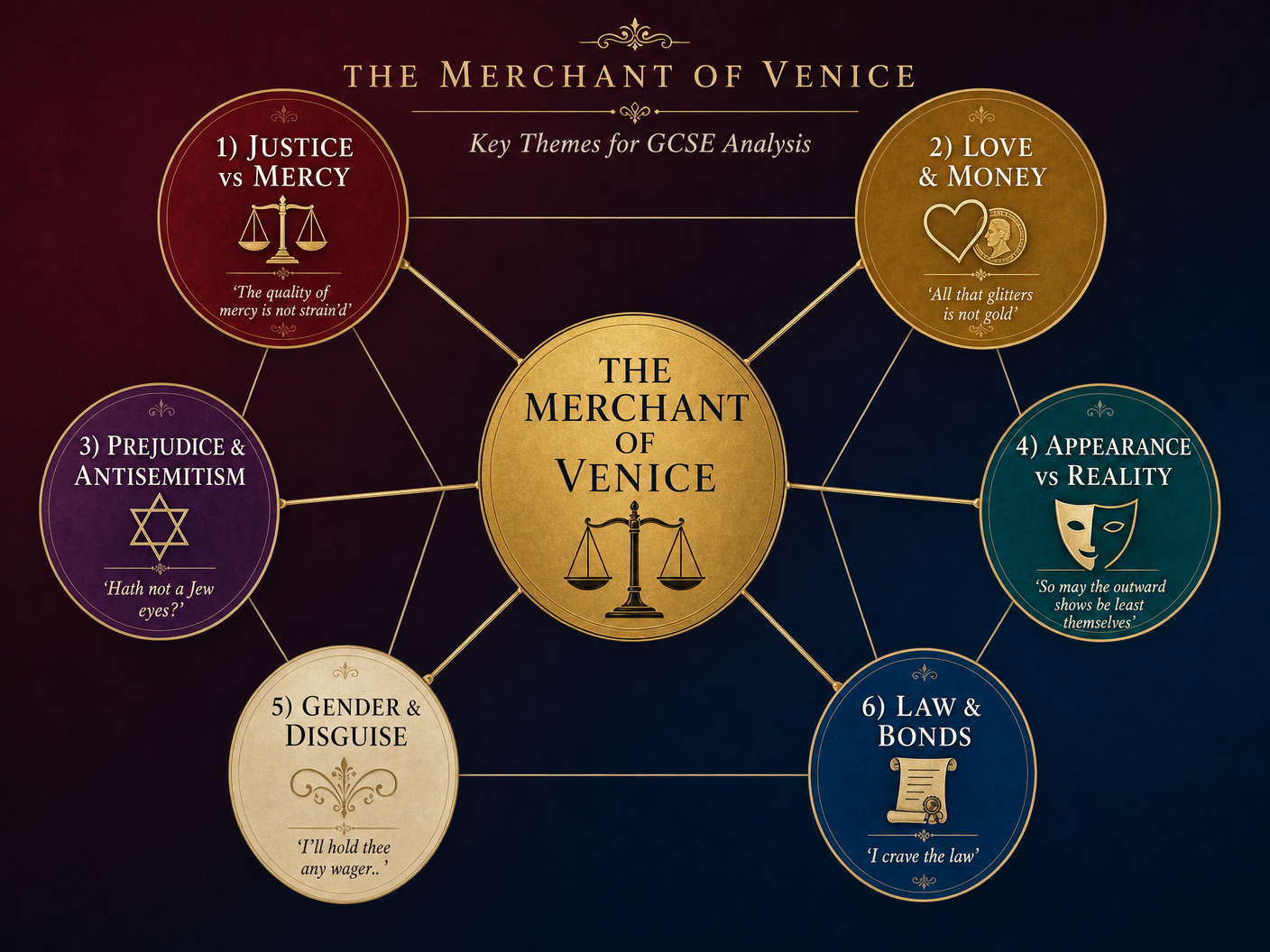
Theme 1: Justice vs. Mercy
The tension between the strict application of the law (justice) and the divine quality of forgiveness (mercy) is the play's central conflict. Shylock represents a rigid, Old Testament view of justice, demanding the exact fulfillment of his bond. Portia advocates for Christian mercy, arguing it is an attribute of God. However, examiners reward candidates who note the hypocrisy here: the Christians demand mercy from Shylock but show him very little when the tables are turned.
Key Quotes:
- "The quality of mercy is not strain'd, / It droppeth as the gentle rain from heaven" (Act 4, Scene 1) - Portia uses natural imagery to suggest mercy should be freely given, not forced.
- "I crave the law, / The penalty and forfeit of my bond." (Act 4, Scene 1) - Shylock's repetition of "law" and "bond" highlights his obsession with legalistic justice.
Theme 2: Prejudice and Antisemitism
Shakespeare presents a deeply divided society. The Christian characters routinely abuse Shylock, spitting on him and calling him a "dog." Shylock's desire for revenge is presented as a direct result of this persecution. Candidates must evaluate whether the play reinforces Elizabethan antisemitic stereotypes or subverts them by giving Shylock profound humanity.
Key Quotes:
- "Hath not a Jew eyes? ... If you prick us, do we not bleed?" (Act 3, Scene 1) - Shylock's rhetorical questions assert his shared humanity, breaking down the artificial barriers erected by prejudice.
- "You call me misbeliever, cut-throat dog, / And spit upon my Jewish gaberdine" (Act 1, Scene 3) - Shylock catalogues Antonio's physical and verbal abuse, providing a psychological motive for his later cruelty.
Theme 3: Love and Money
In Venice, human relationships are transactional. Bassanio describes his pursuit of Portia in financial terms ("a lady richly left"). Even in Belmont, love is tested through material objects (the caskets). The play constantly asks us to evaluate what is truly valuable.
Key Quotes:
- "All that glisters is not gold" (Act 2, Scene 7) - The scroll in the gold casket warns against valuing superficial appearances over inner worth.
- "My daughter! O my ducats! O my daughter!" (Act 2, Scene 8) - Solanio reports Shylock's reaction to Jessica's elopement, mocking him for conflating his child with his wealth.
Character Analysis
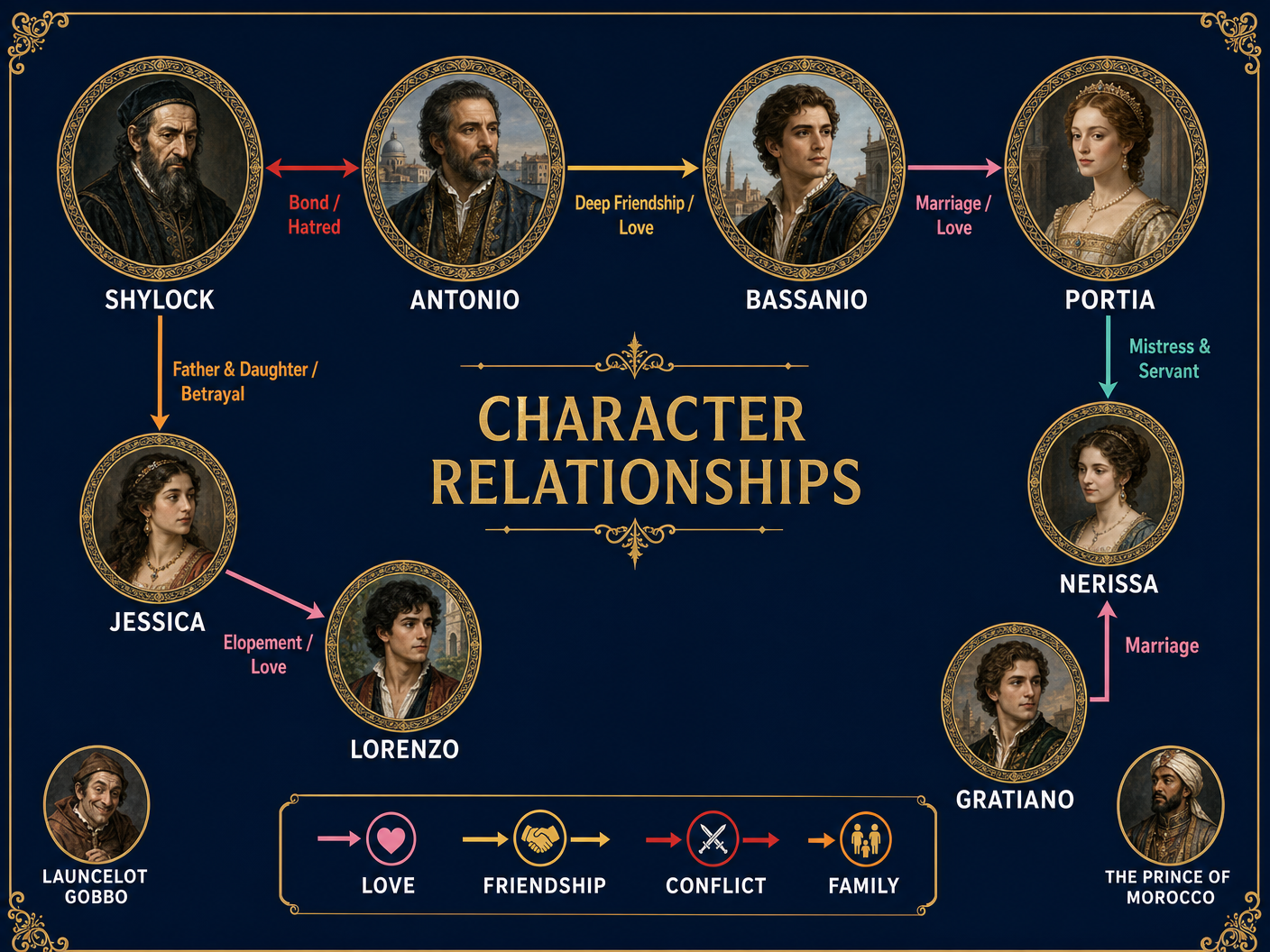
Shylock
Role: The antagonist and Jewish moneylender; the complex center of the play's moral conflicts.
Key Traits: Resentful, legalistic, fiercely articulate, victimized yet vengeful.
Character Arc: Shylock moves from a marginalized but successful moneylender to a grieving father, to a bloodthirsty avenger, and finally to a broken, humiliated man forced to abandon his faith.
Essential Quotes:
- "I will buy with you, sell with you, talk with you, walk with you... but I will not eat with you, drink with you, nor pray with you." (Act 1, Scene 3)
- "The villainy you teach me, I will execute" (Act 3, Scene 1)
Portia
Role: The wealthy heiress of Belmont who saves Antonio.
Key Traits: Intelligent, resourceful, constrained by patriarchy but highly manipulative, eloquent.
Character Arc: She begins as a frustrated daughter bound by her father's will, but seizes control of her destiny, adopting male disguise to wield power in the Venetian court before asserting dominance in her marriage through the ring trick.
Essential Quotes:
- "So is the will of a living daughter curbed by the will of a dead father." (Act 1, Scene 2)
- "Tarry a little; there is something else. / This bond doth give thee here no jot of blood" (Act 4, Scene 1)
Antonio
Role: The titular merchant; Bassanio's devoted friend.
Key Traits: Melancholy, fiercely loyal to Bassanio, antisemitic, passive.
Character Arc: Antonio begins the play in unexplained sadness, willingly risks his life for Bassanio, accepts his impending death with passive martyrdom, and is ultimately saved, though he remains isolated at the end.
Essential Quotes:
- "In sooth, I know not why I am so sad" (Act 1, Scene 1)
- "I am a tainted wether of the flock, / Meetest for death" (Act 4, Scene 1)
Writer's Methods
Form and Structure: The play oscillates between the harsh, commercial world of Venice and the romantic, fairy-tale world of Belmont.
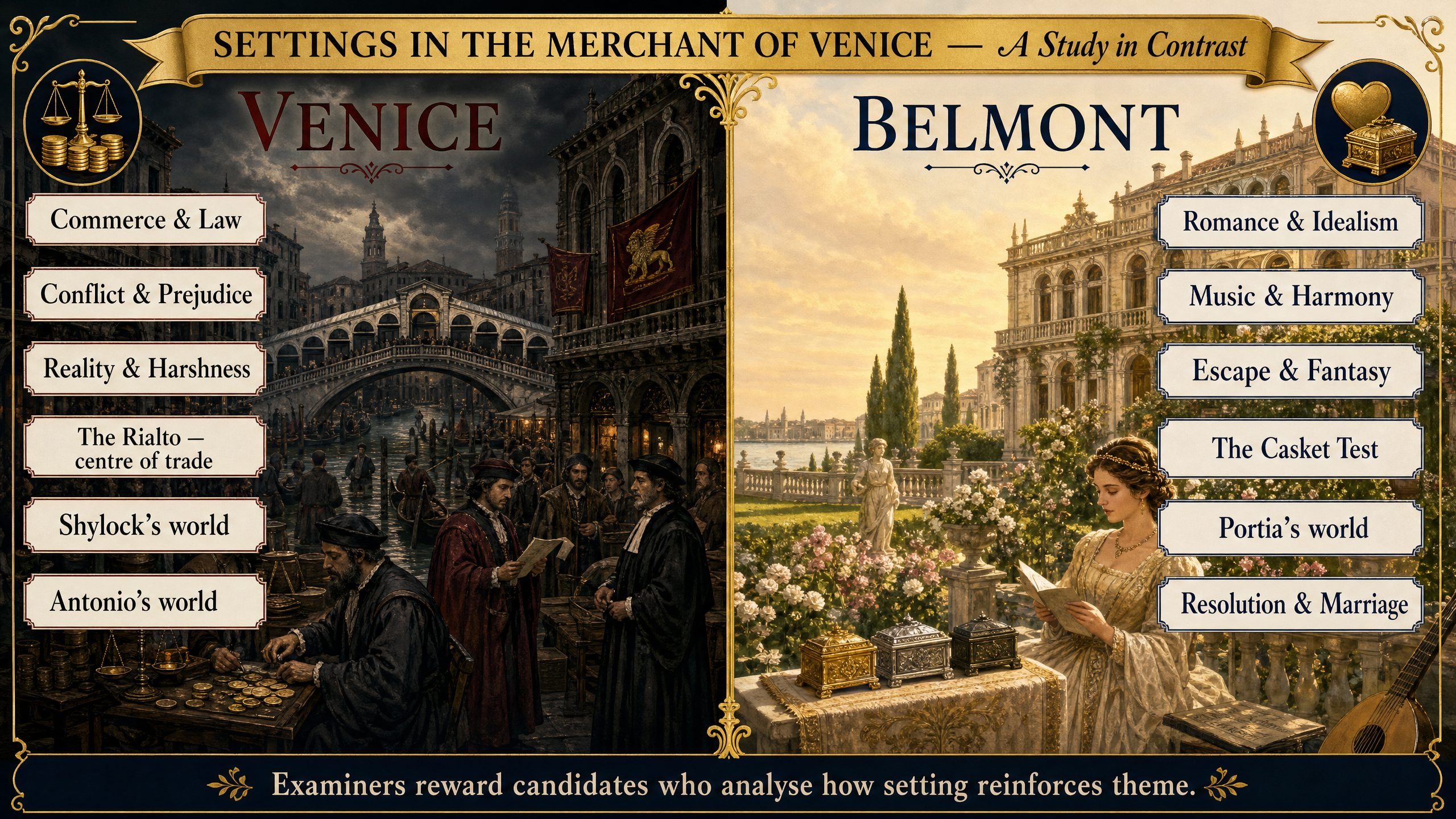
This structural juxtaposition highlights the thematic contrasts between reality and idealism. The climax occurs in Act 4 (the trial), making Act 5 a long, lyrical denouement that attempts to restore harmony, though the shadow of Shylock's destruction lingers.
Language: Shakespeare uses verse and prose to signify status and state of mind. Noble characters generally speak in blank verse (unrhymed iambic pentameter). However, Shylock's most famous speech ("Hath not a Jew eyes?") is in prose, giving it a raw, urgent, and unvarnished realism that cuts through the poetic artifice of the Christian characters.
Symbolism: The caskets symbolize the deceptive nature of appearances. The pound of flesh symbolizes the grotesque extreme of treating human beings as commercial collateral.
Context
Elizabethan Antisemitism: Jews were officially expelled from England in 1290 by Edward I and were not formally readmitted until 1656. Shakespeare's audience would have had little to no contact with practicing Jews. Shylock was largely drawn from cultural stereotypes and literary predecessors (like Marlowe's Barabas in The Jew of Malta). Understanding this helps candidates evaluate whether Shakespeare is indulging in prejudice or critiquing it.
Usury: In Renaissance Christian theology, lending money for interest (usury) was considered a sin, as it was seen as making money breed unnaturally. Because Jews were barred from most professions, moneylending was one of the few trades available to them, exacerbating social tensions.
Patriarchy and Gender: Elizabethan society was strictly patriarchal. Women had few legal rights. Portia's ability to act decisively requires her to assume male dress, highlighting the limitations placed on women.
Visual Resources
3 diagrams and illustrations
Interactive Diagrams
1 interactive diagram to visualise key concepts
Conceptual Flow Outline
The Tragic Arc of Shylock
Worked Examples
2 detailed examples with solutions and examiner commentary
Practice Questions
Test your understanding — click to reveal model answers
Explore how Shakespeare presents the relationship between Antonio and Bassanio. (30 marks + 4 AO4)
Hint: Consider Antonio's melancholy, the financial risks he takes, and how their relationship contrasts with Bassanio's relationship with Portia.
Starting with this extract (Portia's 'quality of mercy' speech), explore how Shakespeare presents Portia as a powerful character. (30 marks + 4 AO4)
Hint: Look at her use of rhetoric in the extract, then contrast it with her initial lack of power in Belmont regarding the caskets.
How does Shakespeare use the settings of Venice and Belmont to explore different ideas in the play? (30 marks + 4 AO4)
Hint: Think of Venice as the world of reality, commerce, and conflict, and Belmont as the world of idealism, music, and romance.
Explore how Shakespeare presents the theme of appearance versus reality. (30 marks + 4 AO4)
Hint: Connect the literal disguises (Portia/Jessica) to the symbolic tests (the caskets) and the thematic hypocrisy of the characters.